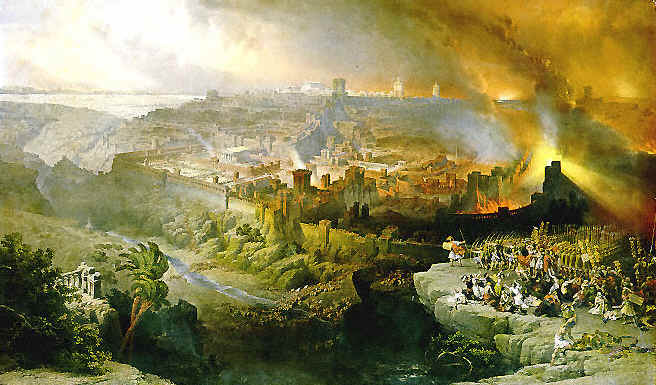
Showing posts with label Eschatology. Show all posts

Thoughts on This Morning's Study

Reading through Isaiah chapter 11 today. We hear this every Advent and I think we sometimes don't pay a lot of attention because it's so familiar.
There shall come forth a shoot from the stump of Jesse,
and a branch from his roots shall bear fruit.
And the Spirit of the LORD shall rest upon him,
the Spirit of wisdom and understanding,
the Spirit of counsel and might,
the Spirit of knowledge and the fear of the LORD.
And his delight shall be in the fear of the LORD. He shall not judge by what his eyes see,
or decide disputes by what his ears hear,
but with righteousness he shall judge the poor,
and decide with equity for the meek of the earth;

So far so good, huh? We all understand this to be talking about Jesus, and what He is going to do when He comes into the world.
Next:
and he shall strike the earth with the rod of his mouth,
and with the breath of his lips he shall kill the wicked.
Righteousness shall be the belt of his waist,
and faithfulness the belt of his loins.

Not so gentle Jesus meek and mild, is it? All kinds of cross references come to mind here; think of Revelation 19 or Psalm 2. Jesus' word strikes the wicked of the Earth, and this comes from His righteousness and faithfulness (He is called Faithful and True).

His striking the earth and killing the wicked results in:
The wolf shall dwell with the lamb,
and the leopard shall lie down with the young goat,
and the calf and the lion and the fattened calf together;
and a little child shall lead them.
The cow and the bear shall graze;
their young shall lie down together;
and the lion shall eat straw like the ox.
The nursing child shall play over the hole of the cobra,
and the weaned child shall put his hand on the adder’s den.

We know this cannot be heaven or the Resurrection. Why? There are children. Whether this animals-gettin'-along business is literal or symbolic, there is no doubt that Christ's rule is to result in amazing peace. So much so that:
They shall not hurt or destroy
in all my holy mountain;
for the earth shall be full of the knowledge of the LORD
as the waters cover the sea.

Here are the promises of God concerning what will happen when He sends His Son into the world. We have already been told that when He comes the increase of His government and of peace will have no end. Here is the glorious "millennium" of His reign and the result of the fruition of its increase.

Wonderful.

The Revelation


As I posted earlier, eschatology keeps rearing its head in several areas of my life lately (more on that later), and so I undertook another detailed look at the Revelation, this time transcribing it and working through Chilton's magnificent commentary on the book.

Just a few thoughts:

1. The book has very little to say about the end of the world.

2. The book has a lot to say about the end of the world--the old world, that is. It is so very obviously primarily concerned with the fall of Jerusalem and the end of the Old Covenant.

3. The similarities and parallel structure to Ezekiel's prophecy are staggering. Why was I never taught this?

4. I tend to agree with the hypothesis that the prophecy was meant to be read liturgically and not all at once.

5. Once one is familiar with the Bible's style of prophetic symbolism (another post on that soon too), the Revelation is not confusing in any way. It's actually very, very clear.

6. It's also very complex, in that the information communicated is very compact. There's much more to it than a quick reading will bring to mind, at least for those of us who aren't as Biblically literate as we should be (like yours truly).

7. There is no "battle of Armageddon." It doesn't ever happen, and there is no place called "Armageddon."

8. Chapter 19 ain't the Second Coming. John sees heaven opened, and Jesus seated on a horse. He doesn't "come" (go) anywhere.

9. The whole point is that Jesus rules, NOW, and we will be victorious in this present age.

10. We're very obviously living in the so-called "millennium." I don't see how anyone can not get that.

Bonus: Man, Dispensationalism is kooky. ;^)

In the Last Days

You have probably heard about this particular "sign" that we are approaching "the end times," from Paul's epistle to Timothy:
But understand this, that in the last days there will come times of difficulty. For people will be lovers of self, lovers of money, proud, arrogant, abusive, disobedient to their parents, ungrateful, unholy, heartless, unappeasable, slanderous, without self-control, brutal, not loving good, treacherous, reckless, swollen with conceit, lovers of pleasure rather than lovers of God, having the appearance of godliness, but denying its power.
Problem: Paul's next sentence to Timothy is:
Avoid such people.

Paul cannot possibly be talking about the days at the end of history.

Done.

One of Dispensationalism's defenses for its position is that "Israel" (defined as "the Jews" or the nation founded in the Forties) has not inherited all the land promised to them by God, ergo, that must happen in the future according to their prophetic scheme.

Problem:

Thus the LORD gave to Israel all the land that he swore to give to their fathers. And they took possession of it, and they settled there. And the LORD gave them rest on every side just as he had sworn to their fathers. Not one of all their enemies had withstood them, for the LORD had given all their enemies into their hands. Not one word of all the good promises that the LORD had made to the house of Israel had failed; all came to pass.


From Joshua. Emphasis mine.

The Prologue of the Revelation

We finished up my "End Times" class by looking at what John wrote about his Epistle. Here 'tis.

End Times and the Epistles

The next recording of my "End Times/Prophecy" class is here.

I'm horrified by all my "uhs" and "y'knows." I'll try to tone it down. I'm not a good public speaker and it's sometimes hard to corral my thoughts into a clear statement...so I buy time that way. Y'know, it's like the "Father God comma" in extemporaneous prayer.

The Olivet Discourse in Mark's Gospel


I'm studying Mark's Gospel right now, copying out a chapter a day by hand. Tonight was Chapter 13, Mark's telling of the Olivet Discourse in which Jesus predicts the destruction of the Temple and the "end of the age."

I find it so incredibly obvious that this passage is not in any way about the physical return of Jesus at the end of time. It baffles me that anyone would take it that way. The Lord repeatedly refers to "you," plural, meaning His apostles who just asked Him about the destruction of the Temple, and caps it off with "this generation shall by no means pass away until all these things take place." Now, you have to make that phrase jump through a lot of hoops to make that mean something other than "y'all standing around Me here." And a lot of people do, because they are confused by the particular kind of language Jesus uses (straight out of the Old Testament, BTW). By doing so they forget that when Scripture addresses a particular group of people, say, the Corinthians, or the Exiles, or the Church at Laodicea, or in this case, Peter, James, John and Andrew, the first application of the Word is to them, and then from that application we may extrapolate what is meant for us to keep and to learn.

"The Last Days"

Tonight, a pastor who I admire greatly was talking about all the Old Testament prophecies "about the Second Coming of Christ."

He was obviously referring to the "last days" or "day of the Lord" prophecies.

Problem: If those prophecies are referring to Christ's Second Coming, they render a belief in Bilical inerrancy impossible. The Apostles clearly stated that the "last days" and the "Day of the Lord" were in their time. If that Day did not in fact come, they were wrong.

Of course, as a preterist, I believe those prophecies are very clearly in reference to the last days of the Old Covenant, ending with the destruction of Jerusalem in A.D. 70. It's the plainest reading of the text, assuming one does not begin with taking Dispensationalism for granted.